
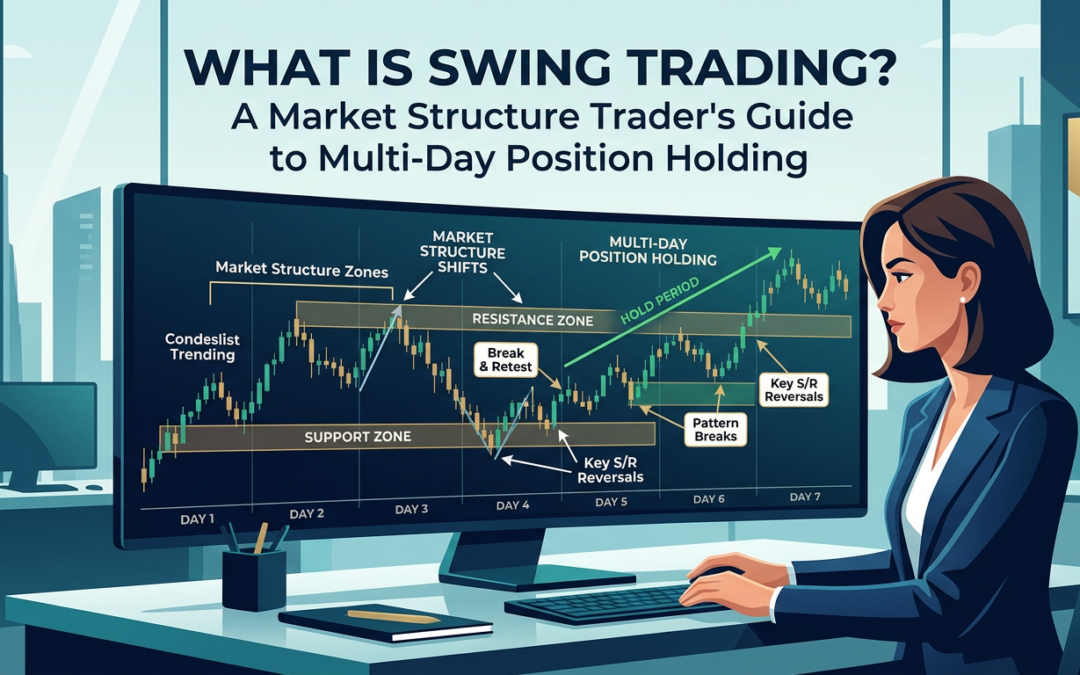
Swing trading sits in the middle ground between scalping and long-term position trading. You hold a trade for anywhere from two days to several weeks, aiming to capture one clean directional move from one structural level to another. No overnight anxiety about missing a tick, no years of waiting for a thesis to play out.
The problem is that most traders approach swing trading as though it is about timing a calendar. They ask “how long should I hold this?” when the real question is “where does this move structurally end?” That shift in thinking changes everything about how you enter, manage, and exit trades.
What Swing Trading Actually Means in Structure Terms
A swing is a directional leg between two structural points. Price moves from a swing low to a swing high in an uptrend, or from a swing high to a swing low in a downtrend. Each of those legs is a tradeable move, and swing trading is simply the practice of positioning yourself at the start of one and exiting near the end of it.
The duration of days or weeks is a byproduct of the timeframe you are working on, not a goal in itself. A swing on the daily chart might take eight to twelve trading days to complete. The same structural move on a four-hour chart might resolve in three days. You are not on the clock. You are in the trade until the structure says otherwise.
Identifying Structural Zones Worth Trading
Before you place a single order, you need to map the market on the higher timeframe. On forex pairs and stock indices, start with the weekly or daily chart and mark the key swing highs and lows. These are the zones where price has previously reversed with conviction, leaving a clear imprint in the data.
There are three structural zones that matter most for swing entries:
- Demand zones at prior swing lows, where institutional buyers have stepped in before and are likely to do so again
- Supply zones at prior swing highs, where price has reversed sharply and sellers have shown their hand
- Break-and-retest levels, where a previous resistance has been broken and price returns to confirm it as support before continuing
The more confluent the zone (for example, a daily demand zone aligning with a 50% retracement and a prior weekly low), the higher the probability of a reaction. You are looking for areas where the market has done something meaningful before, not just random round numbers.
Timing the Entry: Drop Down and Wait
Once you have identified a structural zone on the daily chart, drop to the four-hour or one-hour chart to time the actual entry. You are not buying blindly into support. You are waiting for a structural shift on the lower timeframe that confirms buyers (or sellers) are taking control at that level.
Specifically, look for:
- A break of a short-term downtrend structure within the daily demand zone, signalling that selling momentum has stalled
- A displacement candle (a strong, full-bodied candle) that closes through the most recent lower-timeframe swing high
- A pullback after that displacement that holds above the broken level, giving you a lower-risk entry point
This top-down process keeps you aligned with the dominant structure while giving you a precise entry rather than a wide, uncomfortable guess.
Holding Through the Multi-Day Noise
This is where most swing traders fail. They enter correctly, the trade moves in their favour, and then a retracement or a slow consolidating day spooks them out early. They bank a small profit and watch the full move play out without them.
The solution is to define your trade management rules before you enter, based on structure rather than emotion. Set your stop loss below the structural zone you are trading from. If that zone holds, the trade is still valid. If price closes back inside the zone on the daily chart, the setup has failed and you exit. Nothing in between should move your stop prematurely.
Position sizing matters here too. If your stop is 80 pips away on a daily chart trade, your lot size needs to reflect that distance. Traders who get stopped out by normal price noise are almost always using a lot size that is too large for the timeframe, which forces emotional decisions.
Exiting at Pattern Breaks, Not Arbitrary Targets
The exit is where swing trading on structure really separates itself from generic approaches. You are not exiting because a 1:2 risk-reward target has been hit. You are exiting when the structure that justified the trade breaks down.
For a long trade in an uptrend, exit signals include:
- Price tagging a clear daily supply zone or swing high from the higher timeframe
- A break of the most recent higher low on the four-hour chart, indicating the internal trend is shifting
- A strong displacement candle moving against your position that closes through a structural level you were counting on to hold
A useful approach is to take partial profit at the first structural target (for instance, a prior daily swing high), move your stop to breakeven, and let the remainder run until a genuine structural break occurs. This way you lock in a result early while giving the trade room to deliver a larger return if the move extends.
Swing Trading Timeframes for Forex and Indices
On major forex pairs like EURUSD or GBPUSD, the daily chart is the primary swing trading frame. Moves between key structural levels regularly span 100 to 300 pips and take one to three weeks to complete. Indices like the S&P 500 (US500) and DAX (GER40) offer similar structural swings, though they tend to move faster around news events.
If you prefer faster turnover, the four-hour chart on major pairs can work well. Structural swings there often complete within three to seven days. Just be aware that spreads and session volatility matter more at that level, so focus on the London and New York sessions for entries.
The Honest Trade-Off
Swing trading on structure is not passive. You need to check the daily chart at the close of each session, manage the trade actively, and stay disciplined about your invalidation rules. The reward is that you are not glued to a screen for eight hours, you are not paying high transaction costs from constant in-and-out trading, and you are working with the natural rhythm of how price actually moves.
The market spends most of its time building structure and then breaking it. Swing trading, done this way, is simply the practice of reading that rhythm and positioning yourself in its path.