
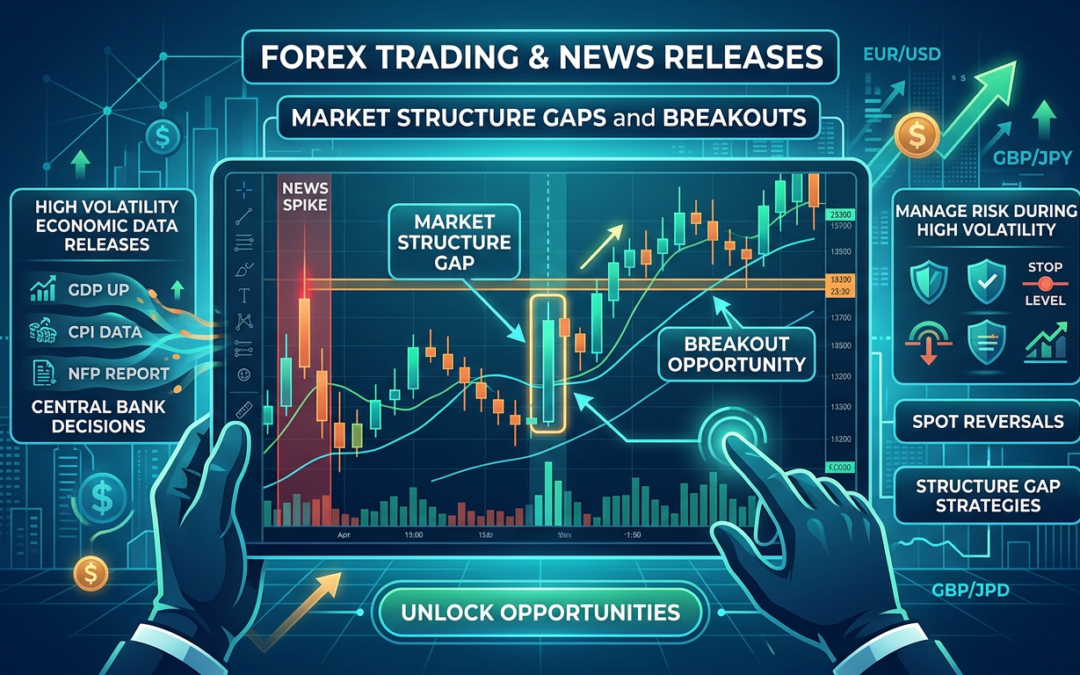
Every week, the economic calendar serves up moments that can move a currency pair 100 pips in seconds. Interest rate decisions, Non-Farm Payrolls, CPI prints, and GDP releases do not just create volatility. They create market structure events: gaps, breakouts, failed breakouts, and liquidity sweeps that leave visible footprints on the chart.
If you trade with a market structure lens, news releases are not random noise to avoid. They are structured opportunities to track, provided you go in with preparation and a clear framework for managing the chaos.
Why News Releases Create Market Structure Gaps
Before a major release, price tends to consolidate. Spreads widen, liquidity thins out, and the market essentially holds its breath. That compression is a structural setup in itself. When the data hits, price jumps through the consolidation range, leaving behind a gap or a sharp expansion candle that often becomes a key structural reference point.
These gaps matter because they represent unfilled orders and displaced liquidity. In market structure terms, the base of a news spike can act as a demand zone. The origin of a sharp reversal can act as supply. Price frequently returns to test those origins after the initial move exhausts itself, and that is where high-probability entries tend to appear.
The key distinction is between a breakout that follows through and one that reverses within the first few candles. A strong NFP beat that sends USD pairs sharply higher on H1 with no immediate wick rejection suggests follow-through momentum. A spike that immediately wicks back into the prior range is a failed breakout, and those tend to reverse hard in the opposite direction.
The Economic Calendar Is Your Pre-Session Checklist
No serious news trader sits down at the terminal without checking what is scheduled. Use a calendar that color-codes impact levels (red, orange, yellow) so you can filter down to what actually moves markets. The events worth focusing on include:
- Central bank interest rate decisions (Federal Reserve, ECB, Bank of England)
- Non-Farm Payrolls and unemployment rate (USD pairs, first Friday of the month)
- CPI and PPI inflation data
- GDP releases (preliminary and revised)
- Retail sales and PMI figures
Know the forecast consensus before the number drops. The market has already priced in the expectation. What drives the move is the deviation from consensus. A CPI print that comes in 0.3% above forecast is a much bigger structural catalyst than one that matches expectations exactly.
Two Core Approaches to News Trading
There are two broad ways traders position around news releases, and both can work within a market structure framework.
Pre-News Positioning
Some traders take a position before the release based on the technical setup and a directional bias. If GBPUSD has been trending bullish, is sitting on a clearly defined demand zone, and UK employment data is due, a long bias going into the print is structurally justified. The risk is that the news contradicts the setup and stops you out immediately.
If you take pre-news positions, widen your stop-loss to account for the spike. A stop placed just below the structural level is correct in theory but can get taken out by the wick before price moves in your direction. Give the trade room to breathe, and size down accordingly to maintain the same absolute risk in pounds or dollars.
Post-News Reaction Trading
The cleaner approach for most traders is to wait for the release, let the initial spike play out, and then look for a structural re-entry. After a major news move, price often pulls back 30 to 60 percent of the initial spike before continuing. That pullback creates a lower-risk entry at the origin of the move or at the first area of structural support or resistance.
On MT4 or MT5, you can use market structure indicators to identify those post-spike swing points quickly. The spike base becomes a candidate demand or supply zone. A pullback into that zone on a 15-minute or 30-minute chart, with a confirmation candle (engulfing, pin bar, or inside bar rejection), is your entry signal.
Managing Risk Around High-Impact Volatility
Risk management during news events is not optional. Spreads on EUR/USD can jump from 0.5 pips to 5 pips or more in the seconds after a major release. Slippage is real. Stops can gap through. Here is how to handle it:
- Reduce position size before the event. If your standard lot size is 0.5 lots on a position, drop it to 0.2 or 0.25 lots when trading through news. The same risk percentage of your account means a smaller position when volatility and stop distance are both elevated.
- Widen stop-losses deliberately. A stop that is structurally correct needs extra buffer during news. Add 15 to 30 pips to your normal stop distance and reduce size to compensate.
- Set a minimum risk-to-reward of 1:2. News trades can move fast and far. Only take the trade if the target is at least twice the risk, given the elevated chance of being stopped out.
- Avoid trading illiquid pairs during news. Exotic pairs like USD/ZAR or USD/TRY can produce 200-pip gaps on a US CPI release. Stick to major pairs where liquidity returns fastest after the spike.
Identifying the Structural Gap as Your Trade Framework
When price gaps or spikes through a prior structure level on news, mark that level immediately. It becomes a key reference point for the rest of the session. A prior resistance that price gapped above on a hawkish Fed statement is now potential support. A prior support that price crashed through on weak payrolls data is now potential resistance.
The gap fill trade is one of the most reliable post-news setups. Price creates a sharp move, gaps through structure, and then pulls back to fill or partially fill that gap before resuming. On a 15-minute EUR/USD chart after a strong CPI print, you might see a 60-pip gap up, a pullback of 25 to 30 pips into the gap area, and then continuation upward. The entry is on the pullback, with the stop below the gap origin and the target at the session high or the next structural resistance.
This is not guesswork. The gap origin is a concrete, visible price level. The pullback gives you a defined entry zone. The risk-to-reward is measurable before you enter.
Building a Pre-News Routine
Consistency in news trading comes from routine, not improvisation. Before any high-impact release, run through a quick checklist:
- Check the economic calendar and note the forecast and previous reading.
- Mark the key structural levels on the relevant pair (nearest swing high, swing low, supply and demand zones).
- Identify the consolidation range forming ahead of the release.
- Decide in advance whether you are pre-positioning or waiting for the post-spike reaction.
- Set your maximum loss for the event before the number drops, and do not exceed it regardless of what happens.
Traders who get hurt badly on news releases almost always skipped step five. Knowing your maximum loss in advance keeps you out of the trap of averaging into a spiking move or holding through a reversal that wipes the day’s gains.
The Bottom Line
News releases are not the enemy of market structure traders. They are the engine that creates the structural events worth trading. Gaps, breakouts, and reversals generated by economic data are among the cleanest setups on the chart precisely because they are triggered by real, measurable information rather than noise.
The traders who profit consistently from news events are the ones who treat them with respect: wider stops, smaller size, a defined structural framework for entries, and a hard daily loss limit. Get those four elements right, and high-impact news days shift from something to fear into something to plan for.