
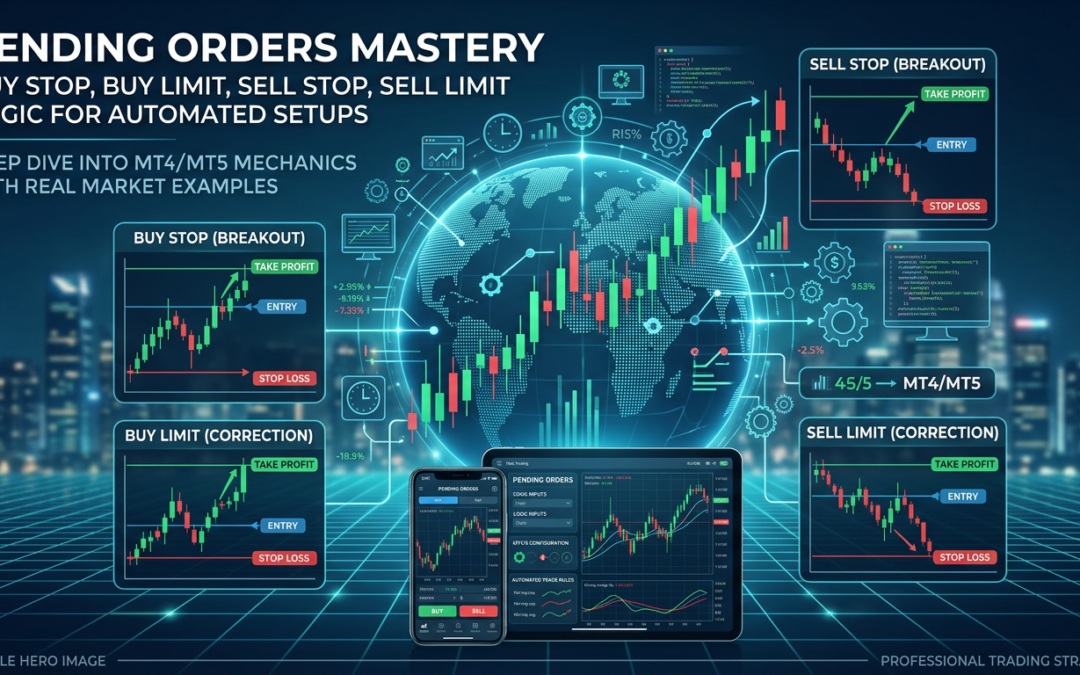
Most traders lose money not because their analysis is wrong, but because their execution is sloppy. They watch price approach a key level, hesitate, then chase an entry three candles too late. Pending orders fix that. They let you define exactly where you want in, lock that decision in before the move happens, and walk away while the market does the work.
MT4 and MT5 both offer four core pending order types. Each one has a specific logic, and using the wrong one at the wrong level is a fast way to get stopped out before the trade even breathes. Here is how each one actually works, and when to deploy them in a structured market structure approach.
The Two Families of Pending Orders
Before going through each order type, it helps to understand the split. Pending orders fall into two categories: limit orders and stop orders. The category determines the relationship between your target entry price and the current market price.
- Limit orders execute at your specified price or better. You are expecting price to reverse when it reaches your level.
- Stop orders execute when price passes through your level in a specific direction. You are expecting momentum to continue after the trigger point.
This distinction matters enormously for market structure trading. A limit order assumes mean reversion. A stop order assumes continuation. Getting them confused leads to entering trades on the wrong side of the logic entirely.
Buy Limit: Entering Long on a Pullback
A Buy Limit is placed below the current market price. You are saying: price is up here right now, but I expect it to pull back to a specific level before continuing higher. When price drops to your order level, the buy executes.
This is the bread and butter of pullback trading. If EUR/USD is trading at 1.0950 and you have identified a strong demand zone or previous structure support at 1.0880, you place a Buy Limit at 1.0880. You do not need to watch the screen. If price reaches that level, you are in. If it does not, the order sits pending until you cancel it or it expires.
In a market structure context, Buy Limits work well at:
- Prior resistance levels that have flipped to support
- Fibonacci retracement zones within a bullish trend
- Institutional demand zones identified on higher timeframes
Sell Limit: Entering Short at a Resistance Level
A Sell Limit is placed above the current market price. You expect price to rally into a defined resistance zone and then reverse lower. When price reaches your level, the short position opens.
If GBP/USD is at 1.2600 and you have a clear supply zone at 1.2700, a Sell Limit at 1.2695 gets you positioned just inside that zone without requiring you to watch price tick up in real time. This is especially useful if the move is likely to happen during a session you are not trading, like the Asian session setting up for a London open reversal.
Sell Limits are particularly effective at:
- Previous swing highs that capped price multiple times
- Supply zones showing prior aggressive selling activity
- Overbought areas on higher-timeframe momentum reads
Buy Stop: Catching a Breakout to the Upside
A Buy Stop is placed above the current market price. This is a momentum entry. You are not waiting for a pullback. You want in only if price pushes through a specific level, confirming strength.
Imagine the S&P 500 index has been consolidating under 5,400 for two weeks. You believe a break above that level signals continuation to new highs. A Buy Stop at 5,402 means you automatically enter the moment price clears that ceiling, without needing to be at your desk watching the tick.
Where Buy Stops make sense:
- Above confirmed consolidation ranges on breakout setups
- Above a key swing high that would signal a higher high in the structure
- On news-driven setups where you want confirmation before committing
One caution: breakout entries carry higher false breakout risk. Placing the order a few pips above the actual level, rather than exactly on it, helps filter some of the noise from stop hunts.
Sell Stop: Entering Short on a Bearish Break
A Sell Stop is placed below the current market price. You are expecting price to break through a support level and continue lower. The order fires when price passes through your trigger.
If USD/JPY is holding above 148.00 but you expect a break lower to accelerate selling, a Sell Stop at 147.90 gets you short as the breakdown confirms. This is useful in trending markets where a clean break of structure signals the next leg down is underway.
Sell Stops are well-suited to:
- Breaks below key swing lows in a downtrend
- Violations of rising trendlines or channel supports
- Breakdown setups following a failed retest of prior support
Combining Pending Orders with Stop Loss and Take Profit
Every pending order in MT4 and MT5 lets you attach a Stop Loss and Take Profit at the time of placement. This is where the real automation power lives. You define your entire trade thesis before the market even touches your level.
When price hits your Buy Limit, for example, you are already in with a pre-set stop below the demand zone and a target at the next resistance. You have not made a single decision in the heat of the moment. The plan was set when your analysis was calm and objective, not when adrenaline is involved.
For position traders using MT4 or MT5 dashboards, this workflow lets you stack several pending setups across multiple pairs simultaneously. You review the charts during your analysis session, place the orders, and the platform handles execution across the week.
One Common Mistake to Avoid
A persistent source of confusion is treating Buy Stop and Buy Limit as interchangeable just because both result in a long position. They are not. A Buy Stop enters on momentum above current price. A Buy Limit enters on a pullback below current price. Placing a Buy Stop below the current market price, or a Buy Limit above it, will result in an instant execution as a market order because the condition is already met. MT4 and MT5 will warn you, but understanding why prevents the mistake in the first place.
The same logic applies to the sell side. Sell Limit above current price, Sell Stop below it. Invert those and you are entering at market immediately, which may not be what your setup requires.
Building a Pre-Market Pending Order Routine
The real edge in pending orders comes from a consistent pre-session routine. Before the London open or New York open, mark your key levels, identify which order type fits each setup, and place the orders with defined risk parameters attached.
This approach removes screen-watching from the equation without removing discipline from your trading. The setup either triggers and plays out as planned, or it does not trigger at all and you stay flat. Either outcome is fine, because the decision was made before emotion entered the picture.
If you are already using MT4 or MT5 indicators for market structure analysis, pending orders are the logical complement. Your indicator identifies the level. The pending order executes the idea. That combination is the foundation of any serious automated or semi-automated trading workflow.