
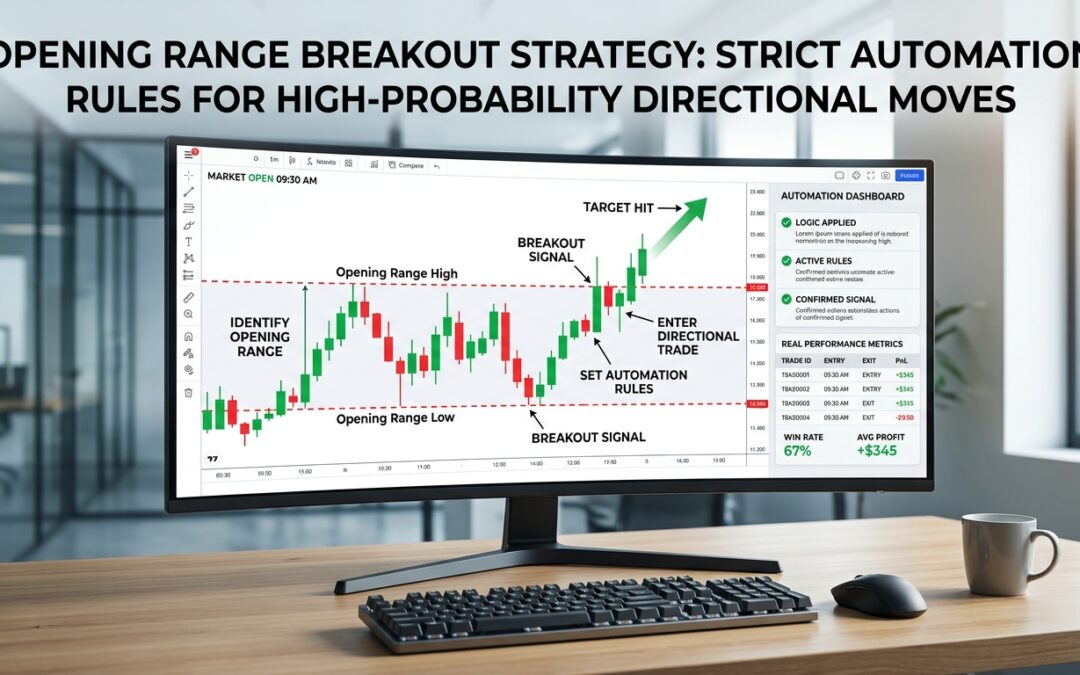
The Opening Range Breakout (ORB) is one of the most studied intraday setups in systematic trading. It is clean, rule-based, and adaptable to automation. If you have been sitting on the sidelines with it, this guide will show you exactly how to structure it so a machine can run it without second-guessing every entry.
What the ORB Setup Actually Measures
The opening range is the high and low established during the first window of a trading session, typically the first 15 to 30 minutes. That range represents the early tug-of-war between buyers and sellers. Once price breaks convincingly outside it, the session often commits to a directional move.
The logic is straightforward. Institutional order flow tends to accelerate in the same direction as the breakout. Retail stops cluster just inside the range. When price exits cleanly, it frequently continues rather than reversing immediately.
Success rates for ORB setups historically fall between 40 and 60 percent, depending on the instrument, session, and filter conditions. That is not an edge by itself. The edge comes from your profit-to-loss ratio and the specific rules that filter out low-quality breakouts.
The Core Entry Rules (Fully Automatable)
To make this machine-executable, every condition needs to be binary. There is no room for discretionary judgment in an automated version. Here is a rules set that runs cleanly in MT4 and MT5:
- Define the opening range using the first 15 minutes of the session (three 5-minute candles for stock indices, or the first 15 minutes after the forex session open you are trading).
- Wait for a 5-minute candle to close above the opening range high for a long, or below the opening range low for a short. A wick breach does not count.
- Cap the opening range size at 0.5% of price. If the range from high to low exceeds that threshold, skip the trade entirely. Wide opening ranges produce choppy breakouts with poor follow-through.
- Only trade in the direction of the breakout. Do not fade it.
The candle-close requirement is critical. Breakout traders who enter on a wick often get stopped out by the snap-back before the real move starts. Closing price confirmation significantly improves the quality of entries.
Stop Loss and Target Placement
Clean automation requires hard rules for exits too. Leaving target management to discretion defeats the purpose of systematising the entry.
- Stop loss: Place it on the opposite side of the opening range. If you are long on a breakout above the high, your stop sits just below the opening range low. This keeps the stop logical and avoids placing it inside the noise of the range itself.
- Target: Use a minimum 1.5:1 reward-to-risk ratio. Many practitioners of this setup use 2:1 or higher. With a 50% win rate and a 2:1 ratio, the math works in your favour across a large sample.
- Time stop: If the trade has not hit target or stop within a defined window (commonly 2 to 3 hours from entry), close it at market. Letting ORB trades run into the afternoon session introduces different volatility dynamics that the setup was not designed for.
Filtering for Quality: What Separates Good Breakouts from Bad Ones
Not every breakout deserves a position. Unfiltered ORB systems take every signal and rely purely on volume to generate returns. Filtered systems take fewer trades but improve the quality of each one.
Here are the filters worth testing on your specific instrument:
- Trend alignment: On a higher timeframe (the 1-hour or daily chart), is the prevailing trend in the same direction as the breakout? Trading ORB longs in a downtrend context reduces the hit rate noticeably.
- Pre-market gap: If the market gapped up into the open on a stock index like the S&P 500, an opening range breakout to the upside has more conviction behind it than a counter-gap break.
- Volume confirmation: For stock indices and individual equities, breakouts on above-average volume have historically shown better follow-through than low-volume breaks.
- News avoidance: Scheduled economic releases in the first 30 minutes (NFP, CPI, FOMC) distort the opening range entirely. Most robust ORB systems skip sessions with major overlapping news.
Setting It Up on MT4 and MT5
For traders using MetaTrader, the ORB is well-suited to automation via an Expert Advisor. The core logic you need to code (or configure) breaks down into four components:
- A function that logs the high and low of the first 15 minutes after your defined session open time.
- A condition check on candle close that compares closing price to the stored high or low.
- A range-size filter that calculates (High – Low) / Open as a percentage and skips the trade if it exceeds 0.5%.
- Automated order placement with calculated stop and target based on the opening range distance.
If you are using an existing ORB indicator on MT4 or MT5, confirm it plots the range based on close confirmation rather than wick penetration. Many free indicators do not make this distinction, and it materially changes your results.
Backtesting and Realistic Expectations
Any claims of 400% returns need to be understood in context. Backtested results on a specific instrument over a specific period can look extraordinary when conditions align perfectly with a momentum strategy. The key question is whether those conditions persist.
When you run your own backtests, focus on these metrics rather than headline returns:
- Win rate across at least 200 trades
- Average reward-to-risk on winning trades
- Maximum drawdown as a percentage of account
- Performance across different market regimes (trending vs. ranging months)
A strategy that shows 55% win rate, 1.8:1 average reward-to-risk, and a 15% max drawdown is a genuinely useful system. A strategy that shows 400% returns in a single trending year with 40% drawdown requires far more scrutiny before you size into it with real capital.
Where ORB Fits in a Position Trading Framework
If your primary approach is position trading on daily charts using market structure, the ORB can serve as a precision entry tool rather than a standalone strategy. When your higher-timeframe analysis flags a key breakout level or a pullback to a prior structure high, you can use the ORB on the next trading day to time your entry with intraday precision.
This hybrid approach reduces slippage on position entries and tightens your initial stop, improving the risk-adjusted return of trades you were already planning to take. The ORB becomes a timing layer, not a separate system running independently.
The setup has earned its reputation for a reason. Apply strict, quantified rules, test it on your specific market, and automate the execution so emotion does not interfere with what is otherwise a mechanical edge.