
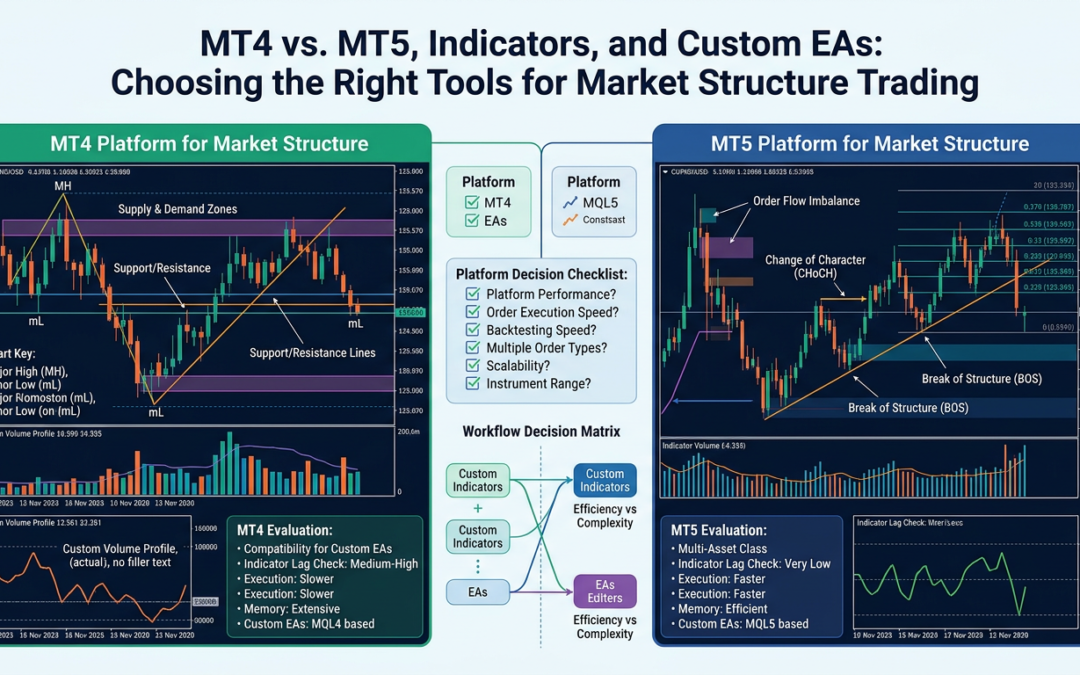
Most trading problems are not strategy problems. They are tool problems. The wrong platform, a lagging indicator, or an EA that misfires on a reversal signal can quietly destroy edge you have spent months building. If your workflow feels clunky, your signals feel late, or your automation keeps behaving unexpectedly, it is worth auditing the tools before you question the strategy.
This is a practical framework for doing exactly that. Work through each section, be honest about what you find, and you will come out with a cleaner, faster, and more reliable market structure setup.
Start With the Platform: MT4 or MT5?
This question trips up a surprising number of traders because both platforms look similar on the surface. Under the hood, the differences matter for market structure work.
MT4 remains the default choice for forex-focused traders who want simplicity and maximum third-party indicator support. The MQL4 language is older but extremely well-documented, and the community library of custom tools built specifically for forex price structure is enormous. If your entire focus is forex pairs and you rely on a tight set of proven indicators, MT4 is hard to argue against.
MT5 is the better choice if you trade stock indices alongside forex, need more timeframes (21 versus MT4’s 9), or want access to depth-of-market data. The MQL5 language is closer to C++ in structure, which makes building sophisticated EAs more manageable. Multi-asset position traders running a mixed book of forex and index CFDs will find MT5 meaningfully more capable.
Ask yourself these questions before committing to either:
- Do all your current custom indicators have a native version for the platform you are evaluating?
- Does your broker’s MT5 feed cover the instruments you actually trade?
- Are you running EAs that were originally built in MQL4? (They require conversion to run natively on MT5.)
Evaluating Your Indicator Suite for Lag
Indicator lag kills market structure entries. The whole point of trading structure is to act at a defined point: a swing high, a demand zone, a break-and-retest. A lagging indicator gives you the signal two or three candles after that point has already printed. You either enter late with a poor risk-to-reward ratio, or you miss the move entirely.
Run a simple back-check on your most-used indicators. Pull up a chart on a pair you trade regularly, scroll back to ten clear market structure turning points, and mark where each indicator would have actually triggered. Then compare those trigger candles to the structural pivot itself. If the average trigger is more than one candle behind the pivot, the indicator is introducing lag that will cost you in live conditions.
Indicators worth auditing specifically for lag include:
- Swing high and swing low detectors (do they paint the label on the candle itself, or wait for confirmation candles?)
- Trend direction filters (do they flip at the structural shift or a candle or two after?)
- Multi-timeframe high and low tools (does the higher timeframe level appear in real time or only after a close?)
A good multi-timeframe high and low indicator, for example, should plot the relevant HTF levels directly on your working chart without requiring you to flip between timeframes. If you are manually switching charts to check where last week’s high sits, that is a workflow problem, not a strategy problem.
Checklist: Is Your EA Actually Compatible With Your Strategy?
Expert Advisors are powerful when they are built to match the logic of your trading approach. They break down when they are not. A generic trend-following EA bolted onto a reversal-based market structure strategy is not automation. It is noise with a script attached.
Work through this compatibility checklist before trusting any EA in a live account:
- Entry logic: Does the EA enter on the same conditions you would trade manually? Specifically, does it look for structural confirmation (a close above a key level, a rejection wick at a demand zone) rather than a simple indicator crossover?
- Timeframe alignment: Is the EA reading the correct timeframe for its signals? An EA scanning M15 for entries while your strategy is based on H4 structure will fire constantly on noise.
- Spread and slippage handling: Does the EA have a maximum spread filter? Market structure trades depend on precise entries. A wide-spread fill at news time can turn a 1:3 setup into a break-even trade at best.
- Position sizing logic: Is risk calculated as a fixed percentage of account equity, or is it a fixed lot? Fixed-lot EAs do not scale correctly as the account grows or drawdown occurs.
- Drawdown limits: Does the EA have a daily or weekly drawdown cut-off? Without one, a string of false breakouts at a structure level can stack losses faster than you expect.
If the EA fails more than two of these checks, it needs to be rebuilt or replaced before it goes anywhere near real capital.
Workflow Efficiency: Where Traders Lose Time Without Realising It
Beyond the technical checklist, there is a softer but equally important dimension: how long does it take you to identify, plan, and execute a trade? If that process is slow or fragmented, you are leaking edge.
Common workflow bottlenecks in market structure trading include:
- Manually drawing the same structural levels on every chart every session (a good indicator suite should handle the majority of this automatically)
- Switching between platforms to cross-check signals (TradingView for analysis, MT4 for execution creates a lag point between decision and action)
- Running too many indicators on a single chart, slowing rendering and creating visual noise that delays decision-making
A clean trading dashboard that consolidates multi-timeframe structure information into a single view is worth far more than a chart loaded with ten individual indicators. The goal is to get from “this pair is interesting” to “this is my entry, stop, and target” in the fewest possible steps.
The Honest Audit Question
After working through the platform choice, the lag check, the EA compatibility list, and the workflow review, there is one final question to sit with honestly: if you stripped your current setup back to three tools and rebuilt from scratch, which three would you keep?
That exercise usually exposes which parts of your current setup are genuinely earning their place and which are legacy clutter you never got around to removing. The traders who execute cleanest are almost always the ones running the leanest setups, not the most complex ones.
Good market structure trading does not require a dozen indicators. It requires the right few, on the right platform, wired together in a way that reduces friction between seeing the setup and acting on it.