
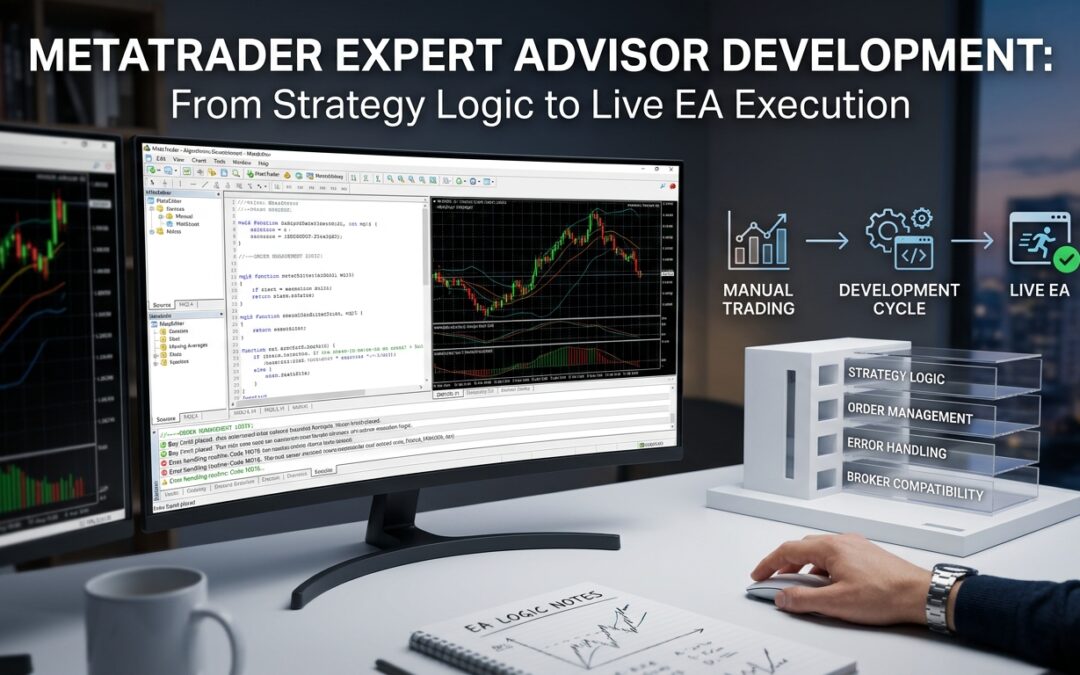
Manual trading has a ceiling. You can only watch so many charts, act on so many setups, and hold discipline through so many drawdowns before the edge starts to slip. For traders working with market structure, that ceiling shows up fast, especially if you are trading across multiple pairs or session overlaps.
Building an Expert Advisor changes that equation. But moving from a well-defined manual strategy to a functioning, reliable EA is not just a coding exercise. It requires thinking clearly about architecture, logic sequencing, order management, and what happens when things go wrong at 3am on a thin market.
What an EA Actually Does Under the Hood
An EA is a program that runs inside MetaTrader and responds to price events. On every new tick or bar close, it executes a series of checks, decides whether conditions are met, and sends or manages orders accordingly. That sounds simple, but the real complexity lives in the sequencing.
A well-built EA separates its responsibilities into distinct blocks:
- Initialisation logic that runs once when the EA loads, checking symbol settings, broker parameters, and account state.
- Signal generation that evaluates your entry conditions on each tick or bar.
- Order management that handles opens, modifications, partial closes, and trailing stops.
- Risk calculation that sizes positions based on account balance, volatility, or fixed risk percentage.
- Error handling that catches failures from the broker side and responds without crashing the program.
Keeping these blocks clean and separate is not just tidy coding. It is what makes the EA testable, adjustable, and debuggable when something inevitably misbehaves.
Translating Market Structure Logic into Code
Most market structure strategies hinge on a few core concepts: identifying swing highs and lows, recognising breaks of structure, finding pullbacks into order blocks or demand zones, and confirming with higher timeframe bias. The challenge is making these concepts unambiguous enough for code to evaluate them.
Take a simple higher high and lower low detection. In your head, you scan the chart and recognise structure visually. In code, you need to define exactly how many bars either side constitute a valid swing point, whether you are looking at closes or wicks, and whether the current bar must close past the previous high or just touch it. Every one of those decisions changes how the EA behaves on historical data.
Start by writing out your rules as a numbered checklist, without any assumptions. If a condition cannot be written as a true or false statement, it is not specific enough to code yet. This discipline often reveals ambiguities in strategies that traders thought were fully defined.
Order Management: The Part Most Traders Under-engineer
Getting into a trade is the easy half. What the EA does after entry determines whether the strategy holds up at scale.
Solid order management logic needs to cover:
- Stop loss and take profit placement on entry, using pip values, ATR multiples, or structure-based levels.
- Modification logic if you want to move stops to breakeven after a certain move.
- Partial close routines if your strategy targets multiple exits.
- Trade count limits per session, per symbol, or per day to prevent overtrading during volatile conditions.
- Logic to avoid re-entering a trade immediately after a stop out on the same signal.
On MT4, order management uses OrderSend(), OrderModify(), and OrderClose(). MT5 uses a different, more structured trade request system through the CTrade class or the OrderSend() function with a MqlTradeRequest struct. The underlying concepts are the same, but the syntax and error codes differ, which matters when you are porting logic between platforms.
Error Handling: What Separates Functional EAs from Fragile Ones
Broker servers reject orders. Requotes happen. The terminal loses connection. Spreads widen at news events. An EA that does not account for these situations will either freeze, double-open positions, or skip valid trades without any record of why.
At minimum, your error handling should:
- Check return codes after every order operation and log the result, even on success.
- Retry failed orders a set number of times before giving up, with a short pause between attempts.
- Detect and handle specific error codes (like invalid stops or not enough money) with different responses rather than one generic fallback.
- Write meaningful log entries to the MetaTrader journal so you can reconstruct what happened during any session.
On MT4, error codes come back from GetLastError(). On MT5, the CTrade class has built-in result checking through ResultRetcode(). Neither platform will automatically tell you something failed silently, so you have to build that awareness into every function that touches the broker.
Backtesting and Optimisation Before Going Live
The MetaTrader Strategy Tester is the first place to validate logic, but raw backtest results are not the goal. You are looking for consistency across different market conditions, reasonable drawdown relative to returns, and behaviour that makes sense given your strategy rules.
Run tests across at least two or three years of data, spanning different volatility regimes. If the EA only performs well on a specific two-month window, the settings are curve-fitted rather than robust. The optimisation tool in MT5 is more capable than MT4’s, supporting genetic algorithms and multi-symbol testing, which helps when you are refining parameters like ATR period, session filter times, or minimum structure size.
One practical step before live deployment is running the EA on a demo account through a full weekly cycle, including the weekend gap open on Sunday. This catches issues with pending order expiry, spread behaviour at market open, and any session filter logic that might behave differently on a live feed versus tick data in the tester.
MT4 vs MT5: Compatibility and Migration
Many traders built strategies on MT4 and are now dealing with brokers pushing MT5. The two platforms use different languages, MQL4 and MQL5, with different function names, data types, and order handling models. Code does not transfer directly.
The migration process has become more manageable with AI tools that can produce a working MQL5 draft from MQL4 source. That draft will still need manual review, particularly around order management functions and any custom indicator calls, but it cuts down the translation time significantly. The bigger task is validating that the ported EA produces the same signals and order behaviour as the original.
MT5 also uses a different account model by default. The netting mode, common with many brokers, means you cannot hold simultaneous long and short positions on the same symbol. If your strategy involves hedging or layering positions, confirm whether your broker offers hedge mode on MT5 accounts before building around that assumption.
Prop Firm Compatibility: A Practical Checklist
If you are building an EA for a prop firm challenge, the rules layer adds another dimension. Most prop firms restrict EAs that use high-frequency trading, trade during news events, or hold positions over the weekend. Some have maximum drawdown rules that require the EA to monitor equity in real time and shut itself down if a threshold is breached.
Before submitting to a prop firm evaluation, check the EA against these common requirements:
- Does it respect maximum daily and total drawdown limits, closing all trades if equity falls to a defined level?
- Does it filter out trading during high-impact news windows?
- Does it avoid overnight or weekend holds if required?
- Does it calculate lot sizes relative to current balance rather than a fixed input, so it scales correctly after funded account increases?
Getting these details right before the evaluation starts is far easier than debugging live positions mid-challenge.
Moving From Manual to Automated Without Losing the Edge
The goal of EA development is not to replace your judgement entirely. It is to remove execution inconsistency from a strategy you already trust. The traders who get the most out of automation are the ones who take time to define their logic precisely, test it thoroughly, and deploy it with clear rules around when the EA should and should not be running.
Start with one clean strategy on one instrument. Get the logic tight, the error handling solid, and the risk parameters set correctly. A simple EA that works reliably is worth far more than a complex one that behaves unpredictably under real market conditions.