
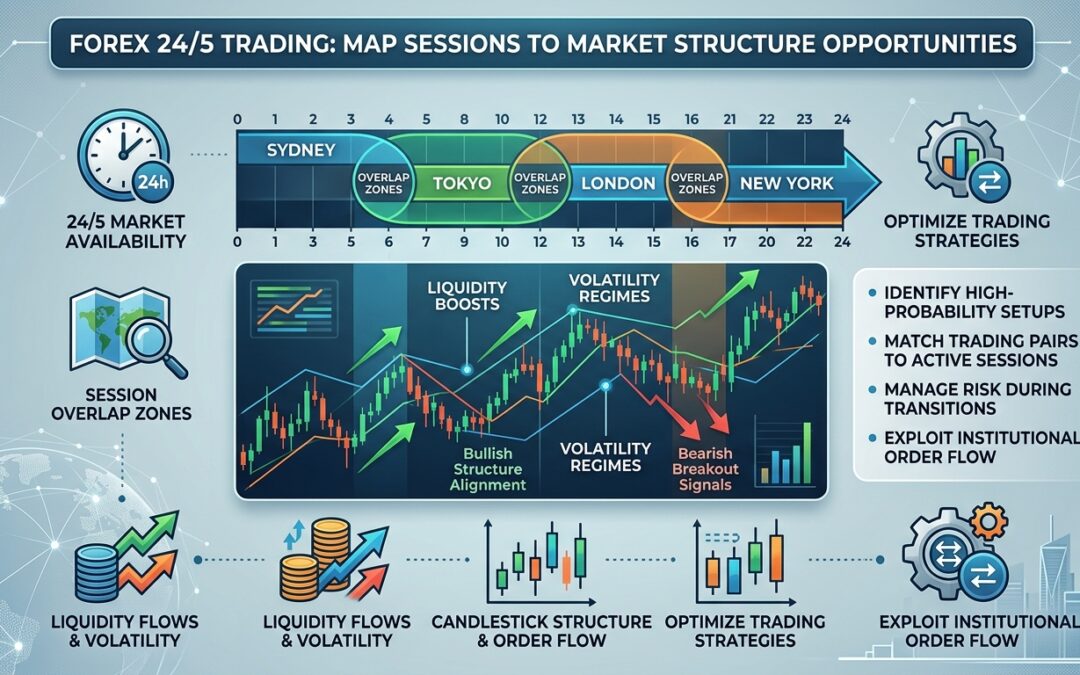
The forex market never truly sleeps from Sunday evening to Friday close, but treating all hours equally is one of the fastest ways to grind your edge down to nothing. Every session has a distinct personality, a specific set of pairs it favours, and a liquidity profile that either supports or destroys clean market structure trades. Get the timing wrong and you are fighting against thin spreads, false breakouts, and noise that looks like structure but is not.
This guide breaks down each major session, what it actually does to price, and how to align your structure setups with the conditions that give them the highest probability of following through.
The Four Sessions and What They Actually Mean for Price
The forex market runs on four overlapping sessions: Sydney, Tokyo, London, and New York. Each one opens and closes in sequence, handing liquidity from one financial centre to the next. The critical insight is not just when they run, but what price tends to do during each one.
Sydney (10:00 PM to 7:00 AM UTC) is the quietest. Spreads are wider, volumes are lower, and price tends to consolidate or retrace within the prior day’s range. It is not a session designed for breakout entries.
Tokyo (midnight to 9:00 AM UTC) picks up activity, particularly on JPY crosses and AUD/USD. Price often establishes a range during the Asian session that becomes the reference point for the London session to break. Recognising this range is useful for structure traders because London frequently targets the liquidity sitting above and below it.
London (8:00 AM to 5:00 PM UTC) is where institutional volume floods in. This is the session that creates the majority of the day’s directional moves. Swing highs and lows from the Asian session get swept, and new structure forms fast.
New York (1:00 PM to 10:00 PM UTC) overlaps with London for four hours between 1:00 PM and 5:00 PM UTC. That overlap window, which corresponds to roughly 8:00 AM to noon EST, is statistically the most liquid and active period in the entire trading week. If you only trade one window, trade this one.
Session Overlaps Are Where Structure Gets Created
Overlaps matter because they stack liquidity. More participants means more real order flow, which means structure levels are respected or broken with conviction rather than fading into noise.
The London/New York overlap is the gold standard for structure traders. During this window, EUR/USD, GBP/USD, and USD/JPY all see their tightest spreads and most defined directional swings. A break of a prior London session high, followed by a pullback that respects the broken level as support, is a textbook structure trade that this overlap delivers consistently.
The Sydney/Tokyo overlap (2:00 AM to 4:00 AM EST) is quieter but still useful for AUD/JPY and NZD/JPY setups. Volatility is lower, so structure levels hold more cleanly, but the moves themselves tend to be smaller. Scalping or tight range plays suit this window better than swing trades targeting large extensions.
Pair Selection by Session
Not all pairs behave well in every session. Matching your pair to the active financial centre is one of the simplest ways to improve setup quality.
- Asian session: AUD/USD, NZD/USD, USD/JPY, AUD/JPY. JPY pairs in particular see genuine directional activity from Tokyo-based institutional flow.
- London session: EUR/USD, GBP/USD, EUR/GBP, EUR/JPY. The pound and euro come alive here. This is where the day’s major structure shifts tend to begin.
- New York session and overlap: EUR/USD, GBP/USD, USD/CAD, USD/CHF. The overlap amplifies London moves and frequently delivers the day’s best continuation or reversal setups.
Trading GBP/USD during the Asian session, or AUD/JPY during the New York close, is not illegal, but you are accepting thin liquidity and slow price action that makes it hard to read structure cleanly.
Volatility Regimes and How They Affect Your Entries
Market structure does not care about time directly, but volatility does. A structure level that held perfectly during a high-volatility London session may get wicked through and recovered during the low-volatility post-New York rollover. The setup is technically the same; the context is completely different.
High-volatility sessions (London open, London/New York overlap, major news releases) tend to produce clean, fast moves from structure levels. You need tighter stops and faster reactions because price moves with intent.
Low-volatility sessions (Asian range, post-New York, Friday afternoon) produce choppy, grinding price action. Structure levels get tested multiple times, fake breakouts are common, and holding through the noise requires wider stops that often do not match sensible risk parameters.
The practical rule: use high-volatility windows for entries at structure, and use low-volatility windows for analysis and planning. The Asian session is ideal for marking up your charts, identifying overnight ranges, and setting alerts. Execute during London or the overlap.
Using the Asian Range as Your Structure Blueprint
One of the most reliable patterns in forex market structure is the Asian range sweep. During Tokyo hours, price consolidates and builds a defined high and low. When London opens, institutional flow frequently targets the liquidity resting just beyond those extremes, stops sitting above the Asian high or below the Asian low.
The trade is not the sweep itself. The trade is the reaction after the sweep. If price breaks above the Asian high and immediately reverses with a strong bearish candle back inside the range, that is a liquidity grab and potential structure reversal. If price breaks above the Asian high and then pulls back to test it as support, that is a structure continuation play.
Mark the Asian range on your charts every single day. It gives you two objective levels that the London session will almost certainly interact with.
What to Avoid: The Dead Zones
Not every hour is worth watching. Two periods consistently produce low-quality setups that trap traders into bad reads on structure.
- The rollover zone (5:00 PM to 7:00 PM EST): Both London and New York are closed or winding down. Liquidity drops sharply, spreads widen on most brokers, and price drifts without purpose. Reversals and fake-outs are frequent.
- Friday afternoon (after 1:00 PM EST): Institutional desks reduce positions into the weekend. Price can make strange moves that have no structural logic because they are driven by position management, not directional conviction. Any setup taken here is fighting low liquidity and weekend-risk squaring.
Sunday open is similarly dangerous. The gap from Friday close creates an initial spike that is often faded quickly. Wait for Tokyo to establish a range before forming any structural opinion on the week ahead.
Building a Session-Based Trading Routine
For traders using market structure as their primary methodology, the most effective daily routine is straightforward.
- During the Asian session, mark daily and weekly structure levels, identify the overnight range, and set price alerts at key zones.
- At the London open, watch how price interacts with the Asian range and higher-timeframe structure. Look for liquidity sweeps and the first strong directional push.
- During the London/New York overlap, execute high-probability continuation or reversal trades at confirmed structure. This is your primary execution window.
- After the overlap closes, step back. Let the late New York session close without interference unless you already have a running trade to manage.
The 24/5 nature of forex is a feature, not a requirement to trade constantly. Most professional structure traders operate inside a defined three to four hour window. The rest of the time is preparation and patience.
Matching your setups to the session that best supports them is not a minor refinement. It is a core discipline that separates traders who read structure well from those who execute it well.