
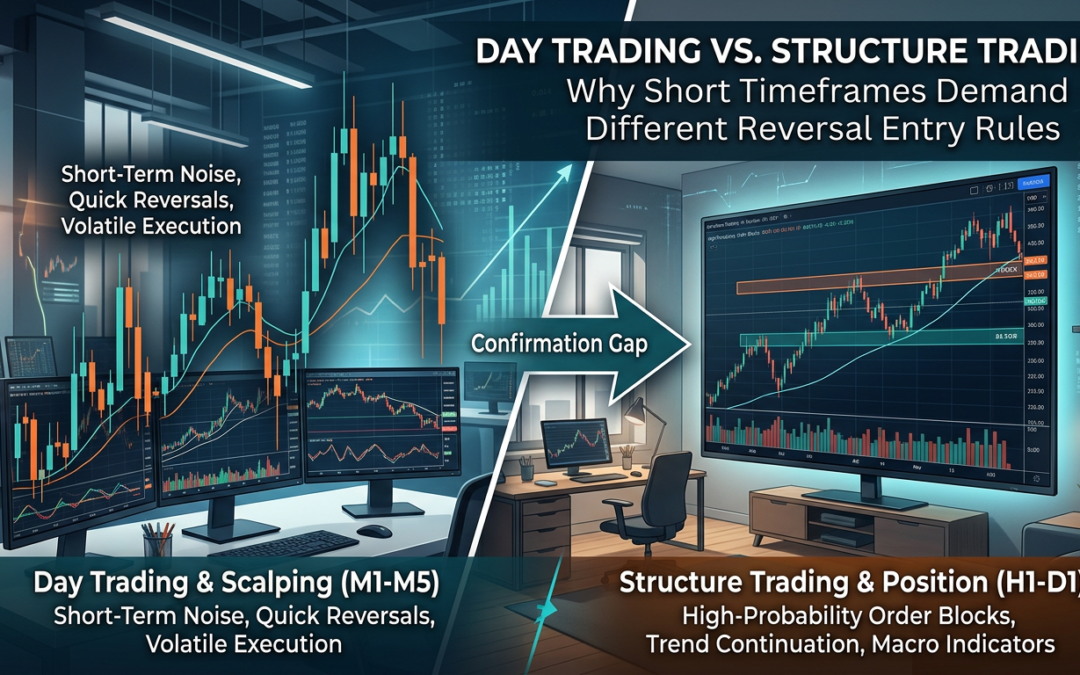
Most traders learn about reversals as if one set of rules applies everywhere. Spot an order block, wait for a reaction, enter the trade. Simple enough on a daily chart. Apply that same logic to an M5 chart during a London session open and the results can be brutal.
The reason is not that market structure is wrong. The reason is that reversals behave differently depending on the timeframe you are trading, and the confirmation you need changes completely. Understanding this distinction is the difference between a repeatable edge and a strategy that looks good in backtests but bleeds out in live execution.
How Reversals Actually Behave on Short Timeframes
On M1 to M5 charts, price is reactive. News, order flow, spread changes, and algorithmic activity all create noise that looks like structure but dissolves within a few candles. A “reversal” on an M1 chart might last 90 seconds before price continues in its original direction. That is not a real reversal. It is a liquidity sweep, a stop run, or simply a brief imbalance being corrected.
Day traders and scalpers who work these timeframes need to account for this. The patterns themselves, things like bull and bear traps, rapid engulfing sequences, and quick demand zone reactions, are real and tradeable. But they require a different confirmation framework than what works on a daily or four-hour chart.
The core issue is that short timeframe order blocks are low-quality by nature. An M5 order block has been touched, tested, and manipulated multiple times before you even see it form cleanly. A daily order block may have never been revisited. That difference in freshness and institutional relevance matters enormously for probability.
What Makes Higher Timeframe Structure More Reliable
Position and structure traders working H1 to D1 charts are not smarter. They are just working with cleaner data. A daily order block represents a point where significant institutional activity occurred. Price moved away sharply, left an imbalance, and has not returned. That is meaningful. When price eventually retraces into that zone, there is a genuine reason to expect a reaction.
Higher timeframe market structure also gives you more room to define your trade clearly. The distance from entry to invalidation is wider in pips, but your risk-to-reward ratio can still be excellent because the move you are targeting is proportionally larger. An M5 scalp might target 10 pips with a 5-pip stop. A daily structure trade might target 150 pips with a 40-pip stop. The math on the second trade is often more forgiving of being slightly wrong on timing.
In 2026, the general consensus among structure-focused traders is that price movement alone is rarely sufficient to read market intent on short timeframes. Confirmation from a higher timeframe context has become more necessary, not less, as algorithmic participation in intraday price action has increased.
The Confirmation Gap Between Timeframes
Here is where most traders get into trouble. They identify a valid higher timeframe structure, then drop to a short timeframe to “refine the entry,” and end up taking a trade that has no real lower timeframe confirmation at all. They are essentially guessing the entry point within a valid zone.
Proper multi-timeframe confirmation works like this:
- Identify the relevant structure on the higher timeframe (H4 or D1). Locate the order block, the imbalance, or the clear shift in market structure.
- Drop to a mid-level timeframe (H1 or M30) to watch how price behaves as it approaches that zone. You want to see deceleration, a failed push, or early signs of demand absorbing supply.
- Only then move to the execution timeframe (M5 or M15) to look for a trigger. This trigger must be a clean structural shift, not just a nice-looking candle. A break of structure to the upside, a clear displacement, or a confirmed engulf of the last down leg all qualify.
Skipping step two is the most common mistake. Traders go from the daily chart straight to the M5 and wonder why their entries keep getting swept before moving in their favour.
Why Scalping Rules Cannot Apply to Structure Trading
Scalpers and aggressive day traders work with very different risk parameters. They expect frequent small losses offset by frequent small wins, with high trade volume. The psychological and technical demands are significant. You need to monitor the market constantly, react fast, and manage positions in real time. Research consistently shows this style demands considerable time and mental energy day after day.
Structure trading, by contrast, is designed for traders who want fewer, higher-quality setups. You might take two to five trades per week rather than ten per day. The expectation is not a high win rate through sheer volume. It is a high win rate through selectivity and patience.
Applying scalper-style entry rules to structure trades, chasing early entries, ignoring the higher timeframe confirmation, treating every short-term bounce as a valid reversal, turns a high-probability methodology into a guessing game with extra steps.
Practical Rules for Each Timeframe Context
If you trade short timeframes (M1 to M15), these rules apply:
- Never take a reversal trade without knowing where you sit relative to the H1 or H4 bias. Trading against the higher timeframe trend from a short timeframe setup is a low-probability play.
- Treat M5 order blocks as triggers only, not as primary reasons to trade. The primary reason must come from above.
- Use tight risk controls. Short timeframe structure breaks down fast. If your stop is 15 pips on an M5 trade, that stop should be beyond a clearly defined structural level, not just an arbitrary distance.
- Accept that your win rate will be lower than on higher timeframe setups. Volume and speed are part of the edge, not just individual trade quality.
If you trade structure on H1 to D1:
- Wait for price to reach your predefined zone before looking for any entry trigger. Anticipating before price arrives is a fast way to get chopped up in the approach.
- Require a lower timeframe structural shift as confirmation. A single candle reaction at a daily order block is not enough on its own.
- Give trades room to develop. A position trade entered on a daily structure setup may need one to three days before it moves meaningfully. Closing early because price is slow is one of the biggest edge-killers in this style.
- Track how many times your identified zone has been tested. A fresh, untouched order block is significantly more reliable than one that has already been partially mitigated.
The Underlying Principle
Timeframe alignment is not a suggestion. It is a structural requirement for consistent execution. The higher the timeframe providing the context, the higher the probability of any given setup. Short timeframes exist to refine entry and reduce risk on a trade that was already identified as valid from above.
When you mix these up, when you treat an M5 signal as the primary reason to trade, or when you apply daily-chart patience to a scalping strategy, you are not just using the wrong tool. You are using the wrong mental model entirely, and no indicator or expert advisor can fix that for you.
Understanding this distinction is what separates traders who grind for years without consistency from those who build a real, repeatable process around a specific style of reading price.