
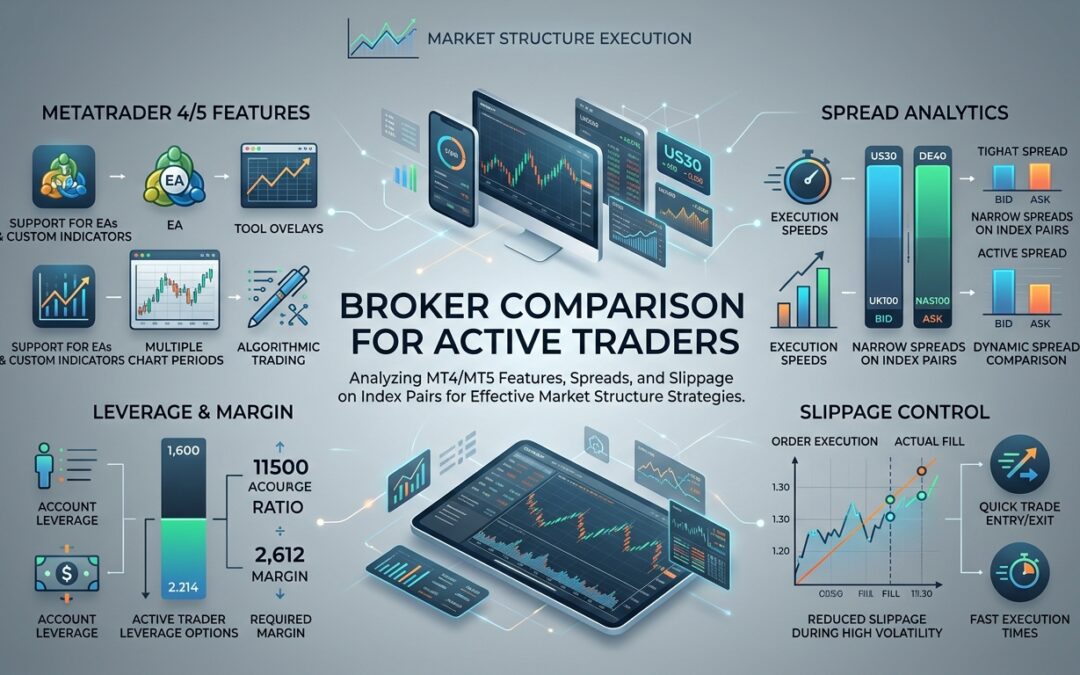
Most traders spend weeks refining their market structure setups, then pick a broker almost at random. That is backwards. The broker you trade through determines your real entry price, your effective risk-reward, and whether your MT4 or MT5 indicators even work as intended. Get the broker wrong and a solid strategy underperforms. Get it right and the edge compounds in your favour.
This comparison focuses on the four factors that matter most for traders running market structure, reversal, and pullback strategies on forex pairs and major stock indices.
Spreads: The Cost You Pay Before the Trade Even Moves
The spread is the immediate drag on every position you open. For a strategy that targets, say, 30 to 50 pips on EUR/USD or a 15-point move on the S&P 500 CFD, paying 2.5 pips in spread versus 0.6 pips is not a minor detail. It is the difference between a positive expectancy model and a break-even one.
Brokers set spreads based on their business model, their liquidity providers, and the instrument in question. ECN-style brokers typically pass raw interbank spreads to the client and charge a flat commission per lot. Market makers bundle their margin into a wider spread and charge no separate commission. Neither model is automatically better, but the ECN route almost always wins for high-frequency or structure-based traders who trade at precise levels.
When comparing brokers, pull the average spread on your actual instruments during your actual session. EUR/USD at 0.8 pips during London open can widen to 3 pips in the 30 minutes before the New York close. Ask for session-specific data, not just the headline figure the broker advertises.
Leverage and Margin: Sizing Your Structure Trades Properly
Leverage is a tool, not a shortcut. For position traders running multi-day structure plays on the Nasdaq 100 or DAX, higher leverage allows you to size correctly relative to your account without tying up excessive margin. For day traders targeting intraday pullbacks on forex, it provides the flexibility to manage multiple setups simultaneously.
Regulatory environment shapes what is available. Retail clients in the UK and EU are capped at 30:1 on major forex pairs under ESMA rules, and significantly lower on indices. Offshore-regulated brokers may offer 100:1 or higher, which matters if your strategy requires it. However, higher leverage also increases broker risk, which is why some offshore brokers have weaker execution infrastructure. The leverage ceiling is one factor; the execution quality behind it is another.
Before selecting a broker based on leverage alone, check what margin is required on your primary instruments. A broker offering 50:1 on EUR/USD might still require a higher dollar margin per contract on the ES or NQ equivalent than a 30:1 broker with better index pricing.
MT4 and MT5 Platform Support: Non-Negotiable for Indicator Users
If you are running custom MT4 or MT5 indicators, expert advisors, or dashboard tools, the broker must natively support the platform version you need. This sounds obvious, but plenty of brokers offer a stripped-down bridge version of MetaTrader that limits the number of custom indicators, caps the tick history available, or restricts EA permissions.
Key questions to ask any broker before opening a funded account:
- Do they offer MT4, MT5, or both? MT5 has depth of market, more timeframes, and a proper economic calendar built in, which matters for structure traders watching sessions.
- Are custom indicators and EAs fully permitted, or are there restrictions on automated trading?
- What is the tick data retention period? Backtesting and optimisation require years of quality tick data, not just daily bars.
- Do they have a VPS service or co-location option for traders who need low-latency EA execution?
A broker that supports MetaTrader but throttles tick data or limits custom MQL4/MQL5 files will undermine any systematic or semi-systematic approach to market structure trading. Test it thoroughly on a demo account before going live.
Slippage and Order Execution: Where Strategies Live or Die
Slippage is the difference between the price at which you place an order and the price at which it actually fills. According to research from B2Broker, slippage is not a system failure but a structural feature of how electronic markets match orders across fragmented liquidity pools. That framing is important: some slippage is unavoidable. The question is how a broker handles it.
There are broadly two execution models relevant here:
- Symmetric slippage: The broker fills orders at the best available price, which may be better or worse than requested. This is the most transparent model for traders.
- Asymmetric slippage: The broker only passes negative slippage to the client, keeping positive slippage internally. This is a significant red flag and effectively a hidden cost.
For market structure strategies, slippage matters most at two points: your entry trigger (especially if you use pending orders at structural levels) and your stop loss. A broker with consistent positive slippage on stop losses is costing you real money on every losing trade, even if spreads look competitive on paper.
The best way to measure execution quality is to look at a broker’s requote frequency, average fill time (ideally under 50ms for ECN brokers), and their stated slippage policy in their legal documentation. Some ECN brokers publish execution statistics quarterly. That transparency is a good sign.
What Actually Matters When You Compare Brokers Side by Side
Here is a practical checklist for evaluating brokers specifically for market structure and index trading:
- Average spread on your primary pair or index during your trading session, not the advertised minimum
- Commission structure (flat per lot vs. variable spread) and the total round-trip cost per trade
- Leverage limits relative to your regulatory jurisdiction and strategy requirements
- Full MT4 or MT5 support including custom indicators, EAs, and sufficient tick history for backtesting
- Execution model (ECN, STP, or market maker) and published fill quality data
- VPS access or server proximity to major liquidity hubs (London, New York, Tokyo) for latency-sensitive setups
- Slippage policy, particularly whether positive and negative slippage are treated symmetrically
No single broker wins on every dimension. An ECN broker with tight spreads may have a higher minimum deposit. A market maker with a polished MT5 bridge might widen spreads during news events. The right choice depends on your strategy timeframe, position sizing, and how actively you trade.
The Bottom Line
A high-probability market structure setup executed through the wrong broker can still produce a losing month. Spreads erode your edge trade by trade. Slippage on structural entries distorts your risk-reward. Poor MT4/MT5 support breaks the tools you rely on for spotting reversals and pullbacks.
Take the time to stress-test any broker on a live micro account before scaling up. Run your indicators, check your fill quality, and compare the actual round-trip cost against your expected average trade profit. That data will tell you more than any broker’s marketing page ever will.