
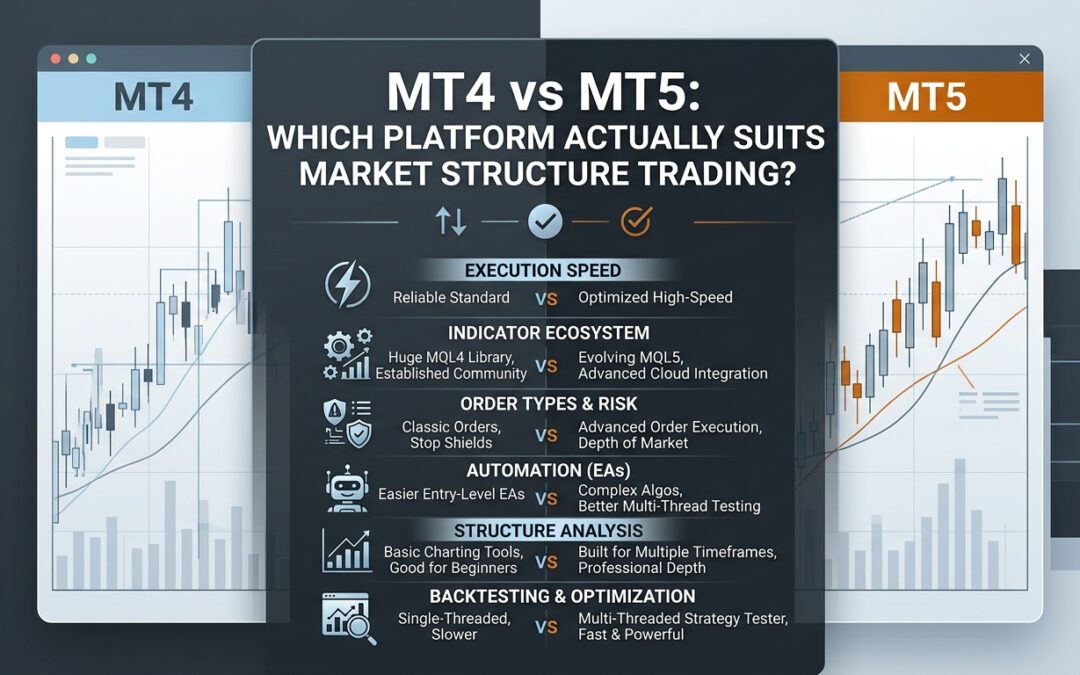
Most platform comparisons spend half their time explaining what a candlestick is. This one assumes you already know. If you trade market structure, you have specific needs: fast indicator loading, reliable order execution, clean automation, and a charting environment that does not fight you when you are trying to identify swing highs, liquidity zones, and structural breaks.
Both MT4 and MT5 can get the job done. But they are not equal for every use case, and picking the wrong one creates friction that costs you time and, eventually, money.
The Core Difference Most Traders Miss
MT4 was built specifically for forex retail trading and released in 2005. MT5 came in 2010 as a full multi-asset platform, not simply an upgraded MT4. MetaQuotes designed them with different goals in mind, which is why MQL4 and MQL5 are separate programming languages and indicators do not transfer between platforms without being rewritten.
That distinction matters immediately for market structure traders. If you have spent time building or buying a custom indicator library in MQL4, migrating to MT5 is not a flip of a switch. You are starting the indicator ecosystem largely from scratch, or you are commissioning rewrites.
Charting and Timeframes
MT4 gives you 9 timeframes. MT5 gives you 21, including M2, M3, M4, M6, M10, M12, H2, H3, and H6. For market structure work, the extra granularity matters. Identifying the exact structure of a reversal or a pullback into a previous high often benefits from intermediate timeframes that MT4 simply does not offer natively.
MT5 also supports more chart windows open simultaneously without the same memory strain you hit with MT4 under heavy indicator load. If you run a multi-timeframe dashboard, a session indicator, a structure indicator, and an ATR overlay across six pairs, MT5 handles that workload more comfortably.
Indicator Ecosystem and Compatibility
MT4 still has the larger ready-made indicator library. The MQL4 community has been building tools since 2005, and the sheer volume of free and commercial indicators available is enormous. Most of the battle-tested market structure tools, including many sold through platforms like this one, were originally built for MT4.
MT5 is catching up fast. MQL5 is a more powerful language than MQL4, supports object-oriented programming properly, and allows indicators to draw on data from multiple symbols and timeframes within a single script. For complex structure tools, that is a genuine advantage. A single MT5 indicator can pull structure data from the H4 chart while running on M15 without ugly workarounds.
The practical answer for now: if you are buying or using pre-built market structure indicators, check which platform they are coded for before you commit to a broker or platform. Running an MT4 indicator on MT5 is not possible without a recompile.
Order Types and Execution
This is where MT5 pulls ahead clearly. MT4 supports two pending order types:
- Buy Stop and Sell Stop
- Buy Limit and Sell Limit
MT5 adds Buy Stop Limit and Sell Stop Limit orders, which allow you to set a stop order that, once triggered, becomes a limit order rather than a market order. For a market structure trader entering on a retest of a broken level, that order type is genuinely useful. You can define the zone with precision instead of hoping a straight stop entry fills at an acceptable price during a fast move.
MT5 also supports partial fills and uses a different position accounting system. Rather than the hedging-by-default model in MT4, MT5 defaults to a netting system, though many brokers now offer hedging accounts on MT5 as well. Check this with your broker before switching, because it affects how you manage multiple trades on the same pair.
Automation and Expert Advisors
MQL5 is a more capable language for building expert advisors. It runs faster, handles multi-threaded operations better, and gives developers more control over execution logic. For an EA built around scanning structure across 20 instruments and placing conditional orders, MT5 is the better foundation.
MT4 EAs still work well for simpler, single-pair automation. If your EA watches one pair, waits for a structure signal, and enters with a fixed lot size, MT4 will handle that without issues. The gap only becomes significant when you push the EA to do more complex work.
MT5 also includes a built-in economic calendar and depth of market panel, which MT4 lacks. Neither is essential for a structure-focused strategy, but the economic calendar integration saves you from alt-tabbing during key news windows.
Strategy Testing
MT5 has a multi-currency, multi-symbol strategy tester. MT4 does not. For market structure traders backtesting a strategy that trades correlated pairs or looks at one pair for signals before entering another, this difference is significant. MT4’s single-symbol tester forces you to build workarounds or accept that your backtest results are incomplete.
MT5’s tester also supports real tick data and variable spreads, which produces more realistic results than MT4’s modelled tick data. If you take backtesting seriously as part of validating a pullback or reversal strategy, MT5 gives you a better picture of real-world performance.
Learning Curve and Broker Access
MT4 remains more widely supported by retail forex brokers. If you trade with multiple brokers or switch frequently, you are more likely to find MT4 available as a default option. MT5 availability has grown substantially, and most serious brokers now offer both, but MT4 still wins on raw availability.
The learning curve between them is not dramatic if you already know MT4. The interface is familiar, the charting logic is similar, and the order placement process feels almost identical. The steeper part of the curve is rebuilding your indicator setup and adjusting any automated tools.
The Honest Verdict for Market Structure Traders
If you are starting from zero or are willing to invest in rebuilding your toolkit, MT5 is the better long-term platform. The extra timeframes, superior order types, multi-symbol backtesting, and more capable automation language all point in one direction. Market structure trading is technically demanding, and MT5 gives you more tools to do it precisely.
If you have a working MT4 setup with indicators, EAs, and templates that you rely on daily, there is no urgent reason to switch. MT4 is not going away, and a reliable setup on MT4 beats a half-built setup on MT5 every session.
The question is not which platform is objectively better. It is which platform gives you the least friction on the strategies you actually run. For most market structure traders building or upgrading their approach in 2024 and beyond, that answer is MT5.